


RUYAH · TRUTH AND REPRESENTATION
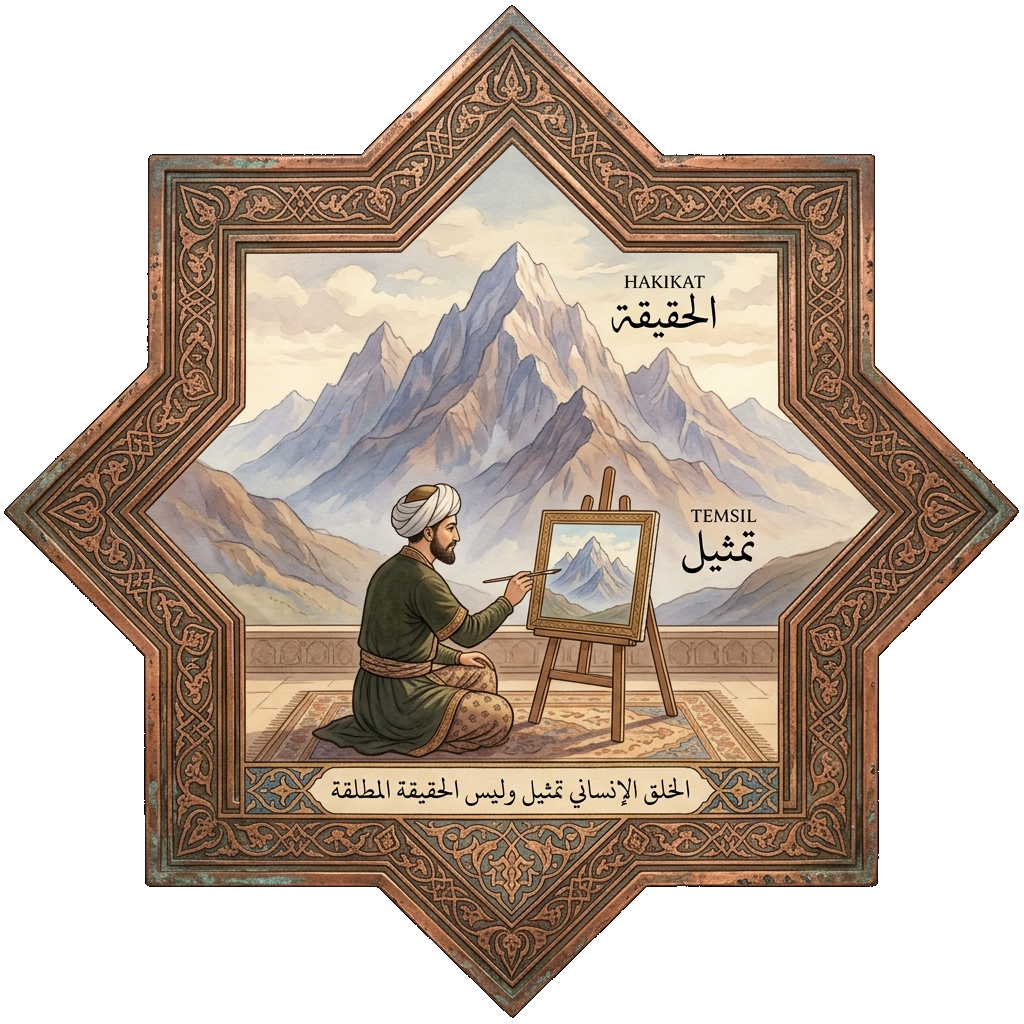
What we build can point to truth without becoming truth itself.What we build can point to truth without becoming truth itself.
We learn from revelation, encounter created reality, observe, measure, organise data and build models, theories, software and institutions. Each can help us understand and act—but each must also show what it rests on, what it leaves out and how it can be corrected.
Why this distinction matters
Human work becomes more trustworthy when it stays faithful to reality and honest about its limits.
We learn from revelation, witness created reality, reason, measure, compare and build representations through language, mathematics, software and machines. This work matters. It also carries a duty to show its sources, choices, omissions and path of correction.
Reality is greater than any model. Representation is human work that reaches toward truth and remains open to correction.
Representation in everyday life
A representation helps us meet reality; it never contains the whole of it.
This distinction does not weaken what we build. It helps us make maps more useful, models more reliable, stories more honest and decisions more responsible.
A map and a city
A map shows routes and distances. It does not contain the city’s people, history, sounds, smells or whole life.
A photograph and a person
A photograph records one moment from one viewpoint. It cannot contain a person’s intention, memory, relationships or full reality.
A weather model and the sky
A model uses measurements to estimate what may happen. The actual sky and each new observation continue to test it.
A translation and the Qur’an
An English rendering can help us understand an ayah. It is human speech, not the Arabic wording of the Qur’an or the whole horizon of its meaning.
Data and a community
Data records selected features. A family, neighbourhood or MILLET cannot be reduced to the fields that happen to be measured.
A language model and human speech
A language model can generate text from patterns. People still carry intention, truthfulness, judgement and responsibility for the consequences.
Levels of knowledge
Reality, witnessing, measurement, data, models, theories and interpretation do not replace one another.
Each contributes something different. A sound order lets us use the strength of every level while keeping sources, assumptions, methods and interpretations visible as we move from one to another.
Architectural direction
Reality → witnessing and observation → measurement → data → model → theory → ontological and metaphysical interpretation.
- 01
Reality
Created reality is greater than every record, classification and model we make of it.
Explore created reality through MA → - 02
Witnessing and observation
Our first testimony through sound senses, embodied presence, reason and direct encounter.
Enter the field through SAFAR → - 03
Measurement
Records defined qualities through a scale, instrument and method. The instrument and its margin of error belong to the measurement.
See how Labs test an idea → - 04
Data
A selected, classified and contextual record of measurement or observation.
Read the data principle → - 05
Model
A computable representation built from data, assumptions and design choices to answer defined questions or estimate possibilities.
Read the model principle → - 06
Theory
A structured explanation that brings several observations and models together and remains open to testing and correction.
Examine claims through Tehâfüt → - 07
Ontological and metaphysical interpretation
A wider judgement about what reality is, the place of the human being and the meaning of the whole. It cannot be presented as though it were simply a measurement result.
Explore direction and limits →
Truth and human work
Truth exists. We turn toward it through revelation, witnessing, reason, disciplined method and work that remains open to correction.
The limits of human work do not make every view equal. One representation may be more faithful to its source, clearer in method, closer to lived reality and better in consequence. Another may distort the context or cause harm. Careful examination by people with the right knowledge helps us tell the difference.
Source and reality
Truth we do not create or exhaust with our own words
Revelation, created reality and actual consequences do not arise from our preferences. We turn toward them, witness them and answer with responsibility.
- Revelation remains distinct from human speech about revelation.
- Reality is greater than data and models.
- The field and actual consequences continue to test every representation.
- Technical power does not erase rights or limits.
Human representation
Our work of understanding, explaining, modelling and building
A representation can approach truth and serve learning or useful work. Its value grows when its source, method, limits and path of correction are clear.
- Show sources, methods and choices.
- State uncertainty and the limits of scope.
- Keep judgement and responsibility with competent people.
- Leave room for examination, counter-evidence, correction and withdrawal.
Representation appears in everything we build
Every work should say what it shows, why it was made and where its competence ends.
Explaining limits does not make a work less valuable. It gives people the clarity they need to trust it, use it wisely and correct it.
Translation, tafsir and commentary
Human work that seeks to understand and explain revelation while keeping source text, translation, interpretation and application distinct.
Mathematical formula
Represents defined relationships and quantities. It does not claim to explain the whole nature of reality by itself.
Scientific model
Explains or predicts defined events. Its success is judged within its scope and tested by new observation.
Dataset and database
Selected, cleaned and classified records whose sources, permissions, context and omissions should remain visible.
Language, image and generative model
Produces outputs through data and design choices. Sources, known errors, intended use and limits should be recorded.
Game, documentary and media
A visible representation shaped by narrative choices, not an absolute judgement about a person, history or community.
Software and interface
Organises workflows and choices. Defaults, authority, objections and the way to leave should be clear.
Institution and programme
An attempt to carry a purpose into life. It is not the ideal order itself and must be examined through its real consequences.
How do we compare representations?
Knowing our limits does not end the search for truth. It makes us test a claim through its source, method, competence and consequences.
A representation can be sounder, more reliable and more beneficial than another. We look beyond how persuasive it appears and ask how it was built and what it produces in life.
Source and scopeState the revealed, scholarly, historical, field or data sources behind the claim and the area it can properly cover. Method and opennessMake selection, classification, measurement, computation, interpretation and transformation open to re-examination. Competence and shared examinationBring domain knowledge, fiqh, technical ability, field experience and counter-evidence together where needed. Witnessing and the real fieldCompare a model or story with the experience of affected people, direct observation and actual consequences. Purpose, rights and limitsLook beyond performance to purpose, privacy, the rights of others, harm, SEDD and HAYR. Correction and careKeep uncertainty, error reports, versions, counter-evidence, correction, withdrawal and ongoing care visible.
Before release and use
Before a text, model, game, piece of software or service is released, it should answer six clear questions.
The aim is not to claim perfection. It is to make the work more accurate, understandable, trustworthy, responsible and open to correction.
01 What is this representation?
Name it clearly as a text, observation, dataset, forecast, scientific model, interpretation, design, artwork or institutional choice.
02 What does it rest on?
Show its revealed, scholarly, historical, field and data sources. Distinguish direct witnessing from reports and interpretation.
03 How was it made?
Explain how selection, measurement, classification, computation, training, interpretation and design serve the intended purpose.
04 What can it tell us?
Make its scope, uncertainty, possible errors, omissions and the judgements it cannot support visible.
05 Who carries the judgement and consequences?
Identify the competent people responsible for the source, field, technique, release, use and real outcomes.
06 How can it be corrected?
Define feedback, objection, versioning, correction, withdrawal, maintenance and, when necessary, abandonment in advance.
Continue from here
Once you can see the limits of representation, explore how sound knowledge and useful work can be renewed as conditions change.
Sabiteler and Tajdid explains how we seek new judgements, institutions, models and tools without abandoning revealed direction. Tehâfüt helps us examine claims presented as necessary or final truth.
Deeper reading
Continue in the Külliyat Library
The portal summary offers direction; the Külliyat record keeps the source, context, and path to longer reading visible.
Atlas
RUYAH Concept Atlas
A concept atlas showing the relations among ADAB, EDEB, TE'DIB, SIDRA, MA, SEDD, İHSAN, SAHN, TEMSİL, MİLLET, and WAQF.
Open the Külliyat recordBook
RUYAH, SAHN.BA and SEMANIYYA Külliyat
A preparation record for a proposed Külliyat that would bring together sources related to RUYAH concepts and the portal architecture.
Open the Külliyat recordReport
BAI Human Oversight Report
A preparation record for a proposed report on human decision, contestability, reversal, representation, and responsibility in the use of models and automation.
Open the Külliyat record