


BA Internet · Media and representation
Content represents not only through what it says, but through whom it shows, how it shows them and where it directs attention.Content represents through whom it shows and where it directs attention.
Writing, images, video, sound, games and synthetic media make people, knowledge, the past and possible futures visible. BAI does not reduce content to consumption and engagement. It brings together sources, audience, human rights, framing, age, limits on distribution and responsibility for correction.
Sources · Human rights · Audience · Framing · Attention · Correction

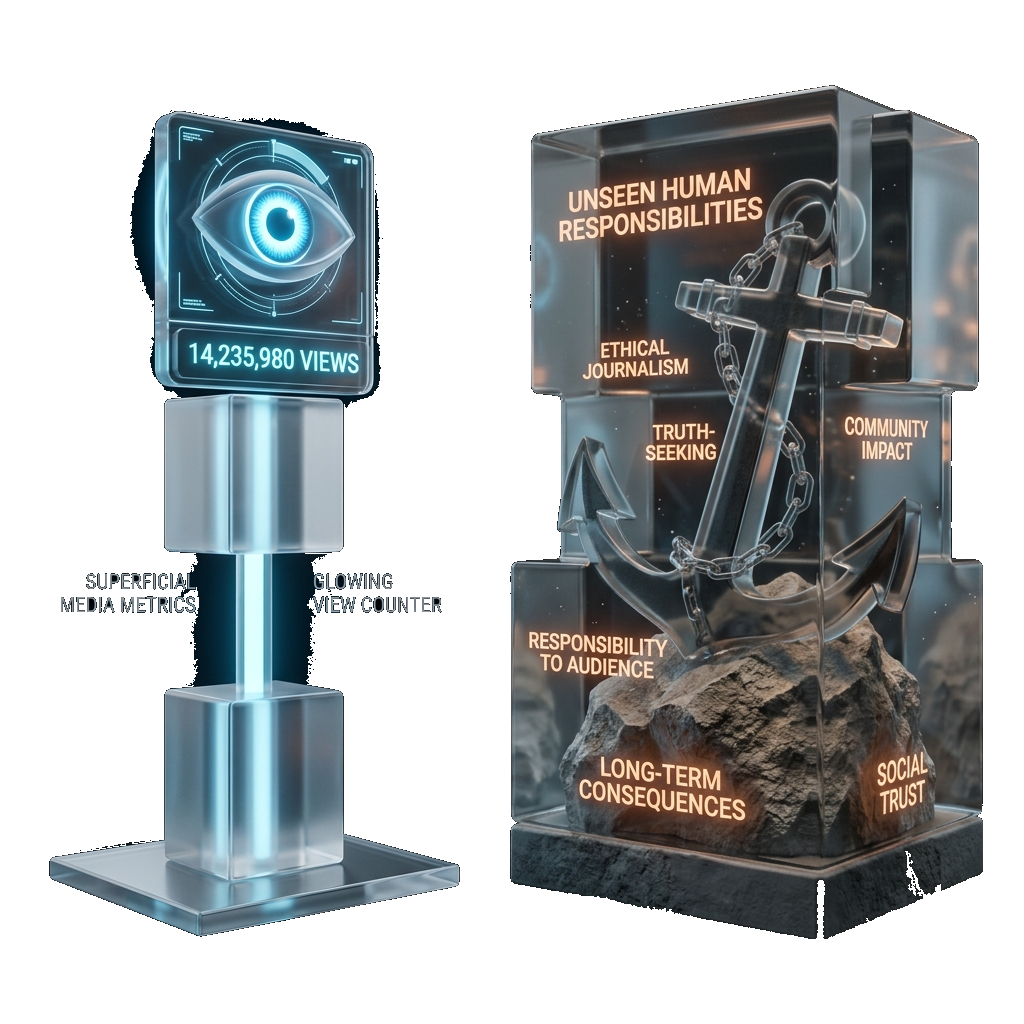
The question
Digital platforms measure visibility; representation also accounts for responsibilities that cannot be seen in a metric.
Clicks, views, shares and follower counts do not tell us whether a piece of content is true, just or useful. A title, frame, edit, soundtrack, game reward, translation choice or synthetic image shapes what an audience sees and feels. The creator carries responsibility not only for the file, but also for the consequences of those choices.
Representation is more than visibility; it is the responsibility to make people and words visible with amanah.
Before making or sharing content
Ask the same six questions about representation.
What are we saying, and which sources support it?Explain the claim, quotation, date and place of an image, the difference between a record and a reconstruction, and what remains unknown. Whom does it show, and whose rights do we carry?Protect permission, privacy, dignity and reuse rights for faces, voices, creative work, private life, children, households and community memory. Who is the audience, and what might they misunderstand?Age, language, prior knowledge, accessibility, sensitivity and context may require the same material to be presented differently. What does the framing reveal or hide?Make visible how the title, frame, cut, sequence, music, colour, pace and game mechanics guide meaning. What are we turning attention into?Does the work nourish curiosity and learning, or does it produce fear, anger, dependency, display and endless consumption? How will it be corrected, limited or removed?Plan error reporting, added sources, apology, versioning, access limits, removal and stopping redistribution before release.
Media and storytelling families
As the format changes, so do the effects of representation and the review it needs.
This is not a complete catalogue. One work may combine writing, images, sound, games and synthetic media.
Writing, research and news
Keep the source chain, quotation, context, title, uncertainty and strength of each claim visible.
Images, video and documentary
Make framing, editing, date, place, permission, privacy and synthetic changes visible.
Sound, speech and music
Protect the speaker’s permission, context, edits, impersonation, synthetic voice and terms for reuse.
Games, simulation and interaction
Examine not only what the player sees, but which behaviour is rewarded, which relations of power become normal and how attention is held.
Translation and multilingual storytelling
Work with native-language contributors to protect concepts, culture, forms of address and local experience beyond word-for-word transfer.
Synthetic and machine-assisted media
Clearly state which parts were generated or changed by a machine, which human data was used and who made the final editorial decision.
From idea to release
Making content quickly matters less than maturing it with a clear sense of what—and whom—it carries.
Children, young people and attention
Holding a child’s interest is not the same as taking possession of their attention.
Content made for children and young people is assessed not only for prohibited material, but also for its effects on relationships, behaviour, reward, privacy and development.
Meaning suited to age
Consider not only plain language, but how a child distinguishes fear, reality, fiction and advertising.
Limits on attention
Do not take over a child’s time through endless feeds, variable rewards, pressure to return or fear of missing out.
Privacy and impersonation
Do not collect, reproduce or use a child’s face, voice, work or behavioural data for model training without explicit household permission.
Human guidance
Do not place a machine character in the role of friend, confidant, teacher or religious authority. Strengthen relationships with family, muallim and guides.
The limit of representation
Framing, editing, translation and machine generation are not truth itself; they are responsible choices made by creators.
A documentary, game or short video all select and arrange. A representation may be faithful to truth, rest on strong evidence and benefit people, yet it still does not exhaust the whole context. Explaining this limit does not weaken the work; it makes it more trustworthy.
A representation may carry something true, but it cannot exhaust truth.
Release and circulation
Not every work is opened to everyone, at every time and under the same permission.
Keep it private
Protect material belonging to a household, child, person, institution or working team when it does not need public visibility.
Share it within limits
Open material that requires a certain age, membership, learning setting, profession, duration or personal permission only to the appropriate audience.
Release it publicly
Publish under clear terms when sources, a representation statement, accessibility, an error path and responsibility for care are visible.
Open it for shared benefit
When rights, permission, privacy, quality, reuse and care allow, the work may become a WAQF candidate. Public content is not automatically WAQF.
Multilingual representation as a MİLLET
Repeating the same message in several languages is not enough; languages and places need a voice in making the work.
Take root in a native language
Shape concepts, stories, humour, forms of address and local experience together with people who live in that language.
Become a guest in another language
Do more than order a translation. Bring the questions, criticism and different ways of seeing from another language Circle into the work.
Verify translation with people
Machine translation can widen access; final decisions about fiqh, history, professional practice and sensitive concepts remain with qualified people.
Make shared work
Let young people, practitioners and storytellers from different places become makers who share sources, framing and consequences—not merely target audiences.
Media and representation review
Would you like to examine a content idea through sources, audience, human rights and limits on release?
Shared Media and Representation Circles within BAI are still in preparation. You can share the question, language, age group, format and guidance you need. This is not a promise of an active studio or programme.