


RUYAH · HAYR and UMRAN
Good intention is not enough; our work must bring goodness into life and remain able to continue after us.Carry goodness into life and continuity.
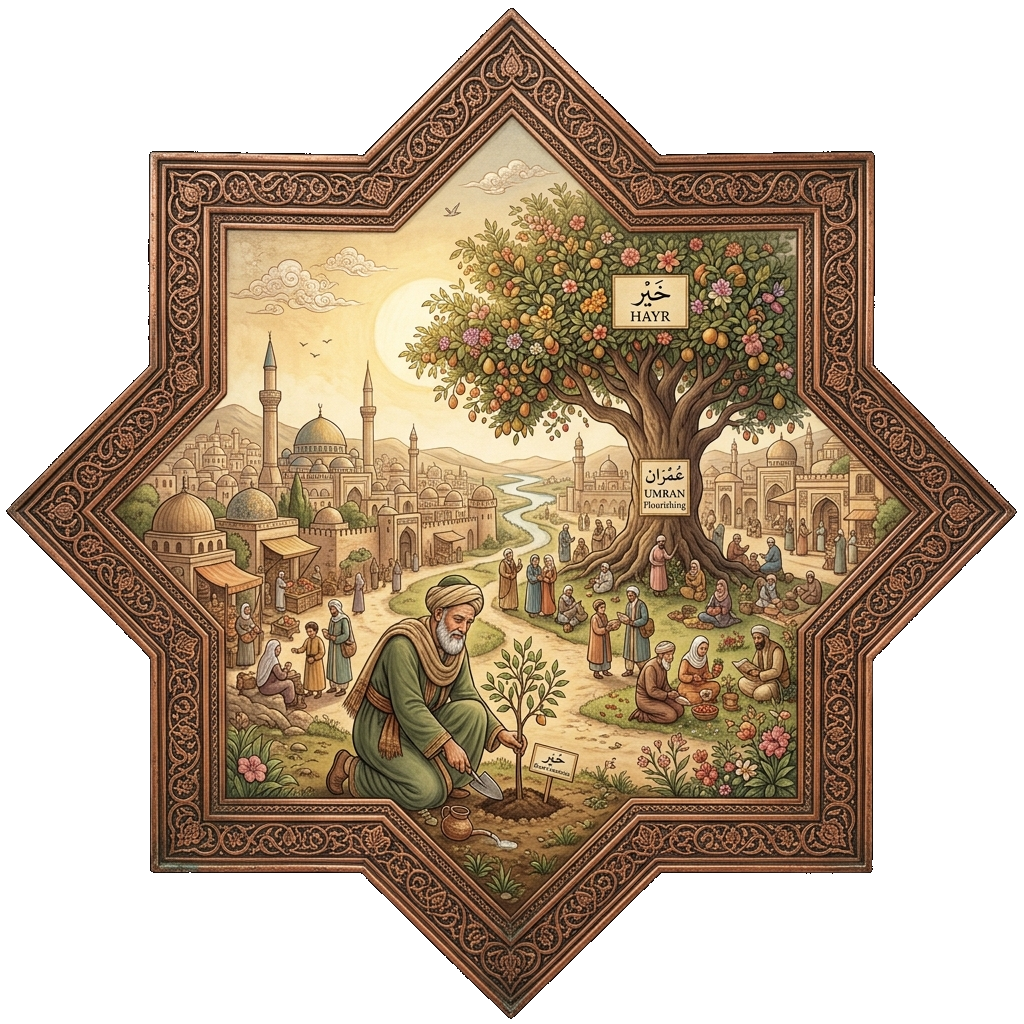
HAYR is the right and life-giving result of an action. UMRAN is the way that goodness becomes a repeatable order in family, education, vocation, institutions, cities and our relationship with the created world.
What is HAYR?
HAYR is not merely looking good; it is a right result that genuinely improves people, rights and life.
A decision, product or institution may be fast, popular and profitable. Yet we cannot call it HAYR without asking who benefits, who bears the cost, which rights it protects and what it will produce in the future. HAYR does not dismiss good intention; it asks that intention to produce justice, trust, well-being and a life-giving result in the real world.
Intention is the beginning; HAYR appears in real consequence.
Three movements from HAYR to UMRAN
Make the purpose clear, see the consequence in real life and build the conditions for goodness to continue.
Good work is not merely launched. Its results are seen, its shortcomings are corrected and it becomes an order that others can also carry.
Intention and purpose
Say clearly why you are acting, whom the work serves and which right you want to protect.
Real consequence
Look beyond claims and figures to what people, labour, relationships, the created world and the future actually experience.
Continuity
Do not leave goodness dependent on one person; prepare its method, care, resources and next bearer.
What does not count as HAYR?
Being liked, growing quickly or generating profit does not automatically make something HAYR.
Visible benefit must be weighed together with hidden costs and long-term consequences.
Being pleasing is not enoughDemand and satisfaction matter, but they cannot determine human rights and the future by themselves. Efficiency is not the only measureFaster and cheaper remains deficient when it costs labour, privacy, quality or safety. The majority cannot see every costMarket demand and votes cannot erase the rights of children, unheard people, local life or future generations. Looking benevolent is not enoughDonations, campaigns and good language cannot conceal exploitation, waste or rights violations in the way the work operates. Short-term benefit is not enoughToday’s convenience must be reconsidered when it leaves debt, dependency, ecological damage or loss of knowledge tomorrow.
What is UMRAN?
UMRAN turns a single good action into an order that people can live, teach and sustain again.
A good lesson becomes an educational order when its method, resources and new teachers allow it to continue. A useful workshop takes root when craft, care and apprenticeship keep it alive. A good digital tool ceases to depend on one person when its sources, limits, maintenance and handover are clear. UMRAN is HAYR growing and continuing within everyday life in this way.
HAYR appears in an action; UMRAN allows that goodness to continue within life.
What does not count as UMRAN?
More buildings, money, technology or institutional scale do not by themselves create a better life.
UMRAN asks not only how much exists, but what kind of relationship we establish with people, labour, place, the created world and future generations.
Not more construction
Life does not flourish when buildings and roads multiply while neighbourhood, access, nature and human scale disappear.
Not more income
Growth does not establish a right order when it produces debt, monopoly, exploited labour or family breakdown.
Not more technology
More devices, data and automation must not weaken human judgement, vocation or privacy.
Not a larger institution
More branches, budget and visibility do not amount to continuity without clear responsibility, accountability, closeness and handover.
Not copying the past
Rather than repeating inherited forms as decoration, we must bring the goodness they carried into today’s conditions.
Not a civilisational display
Symbols and language must find a real counterpart in everyday justice, education, vocation and human relationships.
Putting a right decision into practice
HAYR gives direction; MASLAHAH weighs the circumstances; SEDD limits real harm; IHSAN completes the work with care.
These concepts support one another in decision-making. The aim is not to appear virtuous, but to do the right work under real conditions while protecting people and rights.
HAYR
Asks which result will genuinely improve people, rights and life.
MASLAHAH
Weighs how that goodness can be applied for particular people, times, places, capacities and priorities.
SEDD
Establishes proportionate limits against real harm, exploitation and irreversible consequences.
IHSAN
Completes the work with competence, care, good treatment, maintenance and responsibility to correct mistakes.
Listening and shura
Brings together affected people, field experience and the knowledge of different vocations.
See the result and correct it
Changes the decision, makes amends and tries again when unexpected harm or shortcomings appear.
From person to institution
Good people matter, but sound methods, roles and institutions are also needed so that goodness is not lost within broken systems.
A person’s intention cannot be separated from the order of daily life and institutions. Goodness begins in close relationships, becomes a method in vocation and gains continuity in shared life.
Person and intention
A person knows why they act and carries responsibility for the decision and its consequences.
Family and close life
Care, livelihood, time, children, elders, the table and neighbourhood are the first places where goodness is repeated.
Vocation and method
Competence, labour rights, quality, safety, craft and service establish the measure of everyday work.
Institution and clear responsibility
Authority, budgets, challenge, oversight, remedy and handover carry personal goodness into a lasting way of working.
MILLET and SAHN
People meet around real questions, work together and share responsibility for what their work produces.
WAQF and continuity
Knowledge, tools, places and resources are entrusted so that useful work can continue beyond one person.
Where does UMRAN appear?
UMRAN is not a grand slogan; it is everyday improvement in education, livelihood, technology, cities, the created world and culture.
Each field works through its own knowledge and craft. The shared question is whether we can build a more just, teachable and lasting order without harming people or created life.
Education
Develops curiosity, character, vocation, production and new teachers without reducing knowledge to examinations.
Livelihood and economy
Carries labour, ownership, risk, prices, debt, sharing and solidarity with justice.
Technology
Uses machines without putting them in the human place, attending to privacy, care, sources and human judgement.
City and place
Brings family, neighbourhood, walking, access, safety, worship, production and nature together at a human scale.
Agriculture and the created world
Treats soil, water, animals and seed not as unlimited inputs, but as trusts to protect and sustain.
Culture and media
Creates language, story, art and images without objectifying people, erasing memory or distorting reality.
WAQF and continuity
When good work depends only on its founder, it can easily disappear when the founder leaves.
WAQF helps useful knowledge, tools, places and resources continue without becoming ownerless by defining their rights, care and next bearer.
Open the knowledge
Arrange methods, lessons, documents and suitable tools so that others can understand and use them.
Define the care
Make clear who updates the work, how costs are covered, how errors are reported and when the work should close.
Protect places and tools
Prepare workshops, land, classrooms and equipment for long service rather than short-term use.
Use resources for continuity
Direct income not only to growth, but also to access, education, care, remedy and the next bearer.
Hand over responsibility
Do not hold knowledge and authority in one person; develop a second bearer, a clear method and reliable records.
Preserve memory
Keep mistakes, corrections and lessons as well as successes so that the next person need not pay the same cost again.
Growth and UMRAN
Growth increases quantity; UMRAN improves the quality of relationships, labour, care and continuity.
Growth can sometimes be a useful result. But size, speed and visibility are not proof of a better life by themselves.
When we look only at growth
More users, revenue, construction, data and speed
- We measure success only through numbers and visibility
- We overlook long-term care and the cost of harm
- As the centre expands, family, neighbourhood, craft and local knowledge may weaken
- We value technology according to how far it replaces human labour and judgement
- We treat nature, time, attention and privacy as unlimited resources
- We may place institutional survival before the goodness it was meant to serve
When we look through UMRAN
More just relationships, reliable care and continuity across generations
- We measure success through people, labour, justice, service, the created world and real consequences together
- We include whole-life cost, care, remedy and future generations in the decision
- We strengthen family, neighbourhood, vocation, local capacity and human scale
- We keep technology as a tool supporting human judgement and shared production
- We recognise resources as limited and entrusted, reducing waste and dependency
- We preserve an institution while it serves its purpose; we do not sacrifice the purpose to the institution
Paths that work together
HAYR and UMRAN do not remain on one page; they take life through learning, vocation, shared questions, fieldwork and continuity.
Start through the path that fits your need, then strengthen your work through the others.
RUYAH
Understand why we gather and the direction in which we think about people and our work.
Explore RUYAHKARDESH
Meet people of vocation, share your craft and work together across different fields.
Explore KARDESHMissions, Labs and Build
Research a real question, test on a small scale and make something people can use.
Explore the questionsSAFAR
Meet different people, places and real needs through journeys, visits and service.
Explore SAFARValley
Bring education, agriculture, craft, nature, hospitality and production together in a real place.
Explore ValleyWAQF
Open suitable knowledge and work to HAYR by establishing its rights, care and continuity.
Explore WAQFSix questions about consequence and continuity
Before asking whether work looks good, ask clearly what it does to people and how its goodness will continue.
These questions offer a shared starting point for decisions, products, institutions, education, technology and places.
What are we trying to improve?Are the purpose, the people served and the right we want to protect clear? Who and what will be affected?Have we considered children, family, labour, privacy, local life, the created world and future generations? What is the cost of the visible benefit?Does speed, profit or convenience leave hidden harm to another person, relationship or resource? Have we listened to the right people?Are affected people, field experience and the necessary vocational knowledge part of the conversation? Can the work live in daily life?Can it be repeated through clear roles, method, budget, formation, technology and care? What will continue after us?Is there a next bearer, reliable record, resources, handover, correction and a responsible way to close?
From goodness to continuity
The Concept Atlas shows how HAYR and UMRAN relate to other RUYAH concepts; WAQF shows how useful work can continue.
First see how the concepts connect, then explore how suitable knowledge and work can receive continuing care and a new bearer.
Deeper reading
Continue in the Külliyat Library
The portal summary offers direction; the Külliyat record keeps the source, context, and path to longer reading visible.
Atlas
RUYAH Concept Atlas
A concept atlas showing the relations among ADAB, EDEB, TE'DIB, SIDRA, MA, SEDD, İHSAN, SAHN, TEMSİL, MİLLET, and WAQF.
Open the Külliyat recordBook
RUYAH, SAHN.BA and SEMANIYYA Külliyat
A preparation record for a proposed Külliyat that would bring together sources related to RUYAH concepts and the portal architecture.
Open the Külliyat recordReport
BAI Human Oversight Report
A preparation record for a proposed report on human decision, contestability, reversal, representation, and responsibility in the use of models and automation.
Open the Külliyat record